
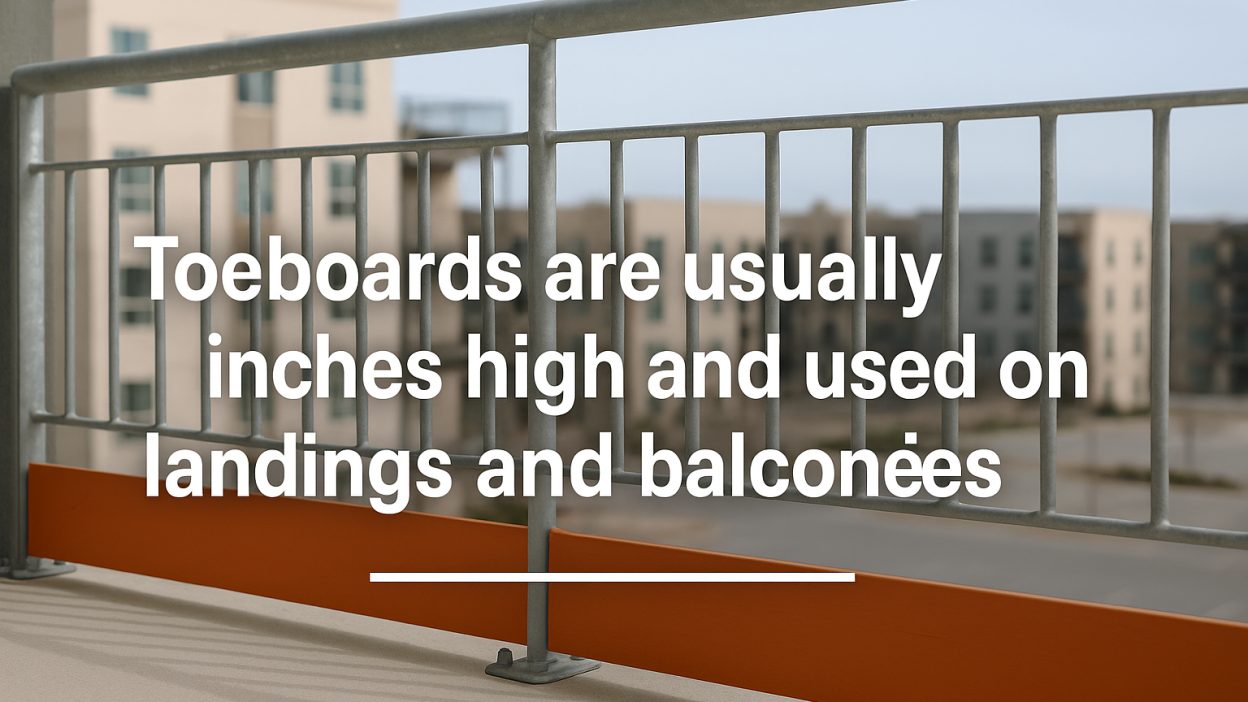
When it comes to workplace safety, small details often make the biggest difference. One of these details is the humble toeboard—a short barrier usually installed along the edge of elevated surfaces like landings, scaffolds, mezzanines, and balconies. You might wonder: toeboards are usually ___ inches high and used on landings and balconies? The answer is 4 inches, as mandated by leading safety standards such as OSHA in the United States.
This article provides a comprehensive, deep dive into everything you need to know about toeboards: their height requirements, why they matter, how they’re installed, and what regulations govern their use. Whether you’re a construction manager, safety officer, building owner, or just a curious learner, this guide will give you clarity, practical insights, and expert-backed information.
What Is a Toeboard?
A toeboard is a vertical barrier, typically made of wood, metal, or composite material, installed at the base of guardrails, scaffolds, platforms, and balconies. Its main purpose is to prevent tools, debris, or materials from falling onto workers or pedestrians below.
Think of it as a “mini wall” at foot level. While guardrails protect people from falling, toeboards protect against objects being accidentally kicked or knocked off elevated surfaces.
Standard Height: Why 4 Inches?
The Occupational Safety and Health Administration (OSHA) in the U.S. and similar organizations worldwide specify that toeboards must be at least 4 inches (10 cm) high. This height is not arbitrary. It’s calculated to:
-
Block most tools and small objects from sliding off.
-
Prevent rolling hazards like bolts, nuts, or hand tools from slipping through gaps.
-
Provide a clear safety line at foot level without becoming a tripping hazard.
Key Regulation (OSHA 1910.29(k)):
“Toeboards shall be erected along the edge of the platform at least 4 inches in vertical height from their top edge to the level of the walking-working surface.”
Where Are Toeboards Required?
Toeboards are not installed everywhere—only where there is a risk of falling objects. Common locations include:
-
Balconies and landings – Preventing tools from falling onto people walking below.
-
Scaffolds – Essential for construction workers working at height.
-
Catwalks and mezzanines – Often in factories, warehouses, and theaters.
-
Elevated platforms – Such as maintenance decks in industrial plants.
-
Guardrails – When guardrails alone cannot stop falling tools.
Example: In 2023, a manufacturing plant in Ohio avoided a serious injury when a wrench dropped from a mezzanine was stopped by a properly installed toeboard. Without it, the wrench could have struck a worker below, leading to hospitalization.
Benefits of Using Toeboards
1. Protecting Workers and Pedestrians
Toeboards act as the first line of defense against falling objects. They minimize injuries from falling hand tools, building materials, and other debris.
2. Legal and Regulatory Compliance
Compliance with OSHA and ANSI standards is mandatory for employers in many industries. Installing toeboards is a straightforward way to avoid costly citations.
3. Preventing Damage to Property
Beyond people, toeboards protect equipment and machinery located below elevated work areas.
4. Enhancing Workplace Safety Culture
When workers see that safety details like toeboards are in place, it sends a message: the employer prioritizes safety.
Materials and Types of Toeboards
Toeboards vary based on the setting. Common types include:
-
Wooden toeboards – Affordable, easy to install, but less durable in outdoor environments.
-
Steel or aluminum toeboards – Highly durable, suitable for construction and industrial use.
-
Plastic or composite toeboards – Lightweight and resistant to corrosion, often used in cleanrooms or food facilities.
Some designs are removable or adjustable, making them practical for temporary scaffolds and modular platforms.
Installation Guidelines
General Steps:
-
Measure the edge length – Ensure coverage across the entire exposed edge.
-
Select the right material – Based on durability, exposure, and compliance needs.
-
Attach securely – Using bolts, welds, or clamps to prevent loosening.
-
Check gaps – Ensure no gap larger than ¼ inch between the toeboard and floor surface.
-
Inspect regularly – Replace or repair damaged toeboards immediately.
Pro Tip: If materials larger than 4 inches in height could fall, OSHA recommends using screening or mesh panels in addition to toeboards.
Common Misconceptions About Toeboards
-
“They’re optional.” – False. If there’s a risk of falling objects, OSHA requires them.
-
“Guardrails are enough.” – Not true. Guardrails prevent people from falling, but not objects.
-
“Any height works.” – Incorrect. Toeboards must meet the 4-inch minimum.
International Standards
While OSHA specifies 4 inches, other organizations have similar rules:
-
European Union (EN 13374): Minimum of 150 mm (about 6 inches).
-
Canada (CSA Z797): Typically 4 to 6 inches, depending on use.
-
Australia (AS 1657): Requires 100 mm minimum (close to 4 inches).
This shows that while the exact dimension varies slightly, the principle remains the same globally: a short barrier is vital for safety.
FAQs About Toeboards
What height are toeboards usually?
Toeboards are usually 4 inches (10 cm) high, as per OSHA regulations.
Are toeboards required on every balcony?
Only if there is a risk of falling objects onto people or equipment below.
Can mesh or screening replace toeboards?
No. Mesh or screening can supplement but not replace toeboards, unless specifically allowed by regulations.
How often should toeboards be inspected?
At least once per shift in construction, and regularly in general industry.
Practical Tips for Employers
-
Always train workers on why toeboards are important.
-
Use bright-colored or reflective toeboards in low-light conditions.
-
Document inspections for compliance records.
-
Consider installing kick plates (a form of toeboard) in warehouses where forklifts operate near mezzanines.
Conclusion
So, to directly answer the key query: toeboards are usually 4 inches high and used on landings and balconies to protect workers, pedestrians, and property from falling objects.
While they may seem like a minor feature compared to guardrails or harnesses, their role in workplace safety is vital. From construction sites to warehouses, a properly installed toeboard can prevent injuries, reduce liability, and foster a culture of safety.
As of 2025, safety regulations continue to emphasize their importance, making them not just a compliance requirement but a moral obligation for employers who prioritize worker safety.
Read Also: Charirvate Explained: Clarivate, Charivari, or Chair Vote


