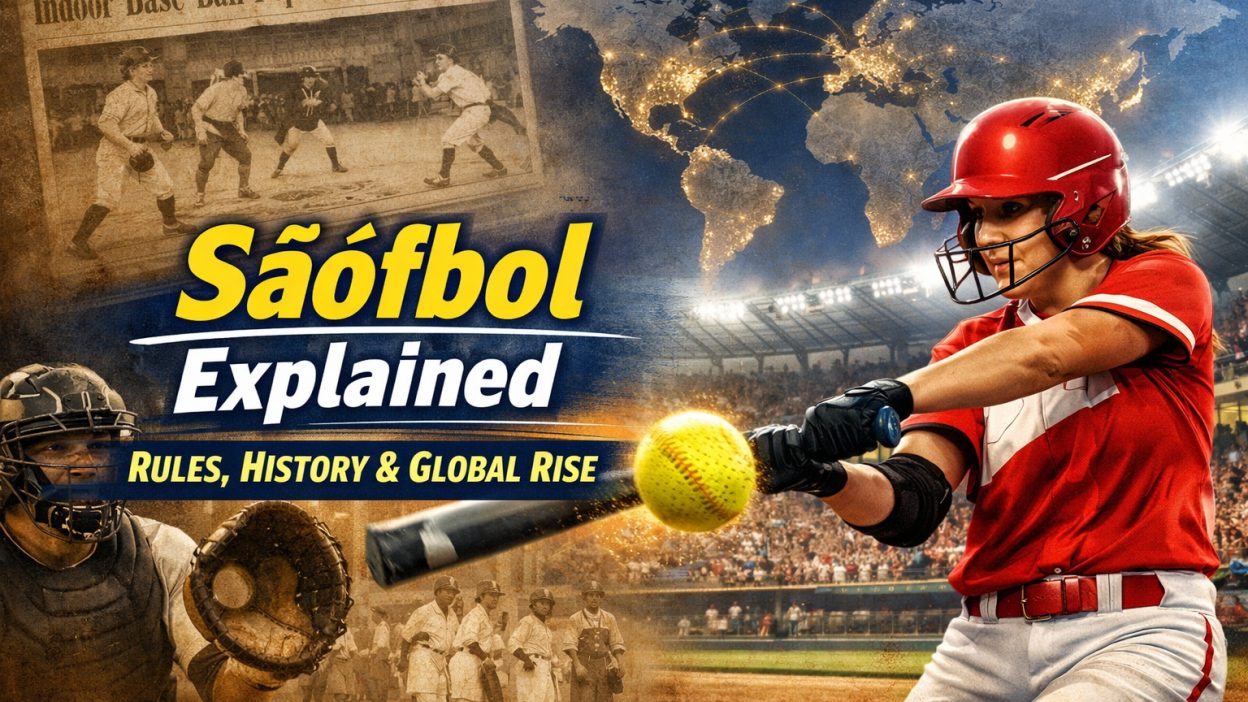
If you’ve come across the term “sã³fbol,” you were almost certainly looking for softball. The unusual spelling often appears due to text encoding issues, especially when the Spanish word “sóftbol” is displayed incorrectly online. Still, behind that small digital glitch lies one of the world’s most dynamic and widely played sports.
Softball is far more than a simplified version of baseball. It is a fast-paced, strategic, and deeply community-driven sport with global reach. From neighborhood recreational leagues to packed collegiate stadiums and international tournaments, softball continues to grow in participation, visibility, and cultural significance. What makes the game so compelling is its blend of accessibility and intensity. It welcomes beginners while demanding elite skill at higher levels.
Understanding softball means looking beyond surface comparisons. It requires exploring its origins, formats, strategy, global development, and why its future looks increasingly bright.
The Origins of Softball
Softball began in 1887 in Chicago, originally as an indoor variation of baseball. The first game was improvised with a boxing glove and a broomstick. What started as a winter pastime quickly evolved into a structured sport played outdoors on smaller fields. By the early 20th century, softball had spread across the United States and into other countries.
The sport’s adaptability played a major role in its expansion. Unlike baseball, softball required less space and could be organized more easily in schools, community centers, and urban environments. As a result, it became especially popular in educational systems and recreational leagues.
Over time, governing bodies formalized rules, standardized equipment, and organized competitions. Today, softball operates under international federations and national associations that oversee structured development pathways from youth leagues to elite championships.
Understanding the Game
At its core, softball follows the same basic structure as baseball. Two teams alternate between offense and defense. The offensive team attempts to hit a pitched ball and run the bases to score runs, while the defensive team works to record outs and prevent scoring.
However, the differences are significant enough to create a distinct identity.
Field and Equipment Differences
Softball fields are generally smaller than baseball fields. Base paths are shorter, and the pitching mound sits closer to home plate. The ball itself is larger, typically measuring around 12 inches in circumference for fastpitch play. This affects grip, spin, and overall game dynamics.
The reduced distance between pitcher and batter dramatically increases reaction time pressure. Plays unfold quickly, forcing athletes to sharpen reflexes and decision-making.
Pitching Style
Perhaps the most defining feature of softball is its underhand pitching motion. In fastpitch softball, pitchers use a windmill-style delivery that can generate impressive velocity and late ball movement. While the motion appears smoother than overhand pitching in baseball, the speed and spin can be equally challenging for hitters.
In slowpitch softball, the pitch arcs upward before descending toward the strike zone. This format emphasizes contact and often produces higher-scoring games, making it ideal for recreational leagues.
The Different Forms of Softball
Softball is not a single uniform experience. Its multiple formats contribute to its global popularity.
Fastpitch Softball
Fastpitch is the elite version of the sport and is commonly played at high school, collegiate, and international levels. The pace is intense, and strategy plays a central role. Teams rely heavily on pitching precision, defensive coordination, and situational hitting.
This format has gained significant visibility in recent years, particularly through collegiate championships and international competitions.
Slowpitch Softball
Slowpitch is more common in adult recreational leagues. The higher arc of the pitch increases batting contact and lowers the barrier to entry. It creates a social, community-focused atmosphere while still offering competitive structure.
Because it is easier for beginners to pick up, slowpitch often serves as an entry point into the sport.
Youth and Developmental Leagues
Youth softball programs emphasize fundamentals. Throwing mechanics, fielding technique, and teamwork take priority over specialization. These programs form the backbone of the sport’s sustainability.
In many countries, grassroots investment has strengthened the youth pipeline, ensuring that talent continues to rise through organized systems.
Strategy and Skill Development
Softball rewards intelligence as much as athleticism. The compressed field dimensions mean there is less margin for error. Coaches must think several plays ahead, and players must anticipate situations in real time.
Offensive Strategy
In fastpitch softball, offensive decisions are often situational. Coaches weigh the value of bunting to advance a runner versus swinging aggressively for extra-base hits. Because games are typically lower scoring than slowpitch contests, a single run can carry significant weight.
Speed also plays a central role. A quick runner can turn routine ground balls into infield hits, forcing defensive errors and shifting momentum.
Defensive Precision
Defensive execution is critical. Fielders must position themselves based on batter tendencies and game context. Communication is essential to avoid misplays.
Pitchers, in particular, function as strategic leaders. They must vary speed and placement to disrupt timing. Catchers assist by reading hitters and guiding pitch selection.
The result is a game that feels compact yet tactically layered.
Global Growth and Governance
Softball’s international presence has strengthened considerably over the past two decades. The World Baseball Softball Confederation oversees global competitions and works with national federations to expand participation.
Countries across Asia, Latin America, Europe, and parts of Africa have invested in structured leagues and youth development programs. International tournaments now feature deeper competitive fields, with emerging nations challenging traditional powerhouses.
The sport’s inclusion in major multi-sport events has also elevated its global profile. While its Olympic status has varied across cycles, appearances on that stage have generated significant spikes in interest and funding.
Beyond elite competition, local federations continue to formalize coaching standards and officiating certifications. These systems ensure that growth is not merely recreational but organized and sustainable.
The Rise of Collegiate Softball
One of the most visible growth engines for softball has been collegiate athletics. In the United States, NCAA softball has experienced record-breaking attendance and television viewership.
High-profile programs now draw crowds that rival other established collegiate sports. Some universities have even staged games in larger football stadiums to accommodate demand.
This surge is not accidental. It reflects broader cultural shifts supporting women’s sports, combined with improved broadcast coverage and athlete storytelling. Fans connect not only with the action but with the personalities and journeys of players.
As media investment increases, collegiate softball continues to shape public perception of the sport’s legitimacy and excitement.
The Cultural Impact of Softball
Softball occupies a unique cultural space. For many communities, it is a rite of passage. School teams become symbols of pride. Weekend tournaments transform into social gatherings that strengthen local identity.
Importantly, softball has long served as a primary competitive outlet for girls and women. It has created scholarship pathways, professional aspirations, and leadership opportunities in coaching and administration.
This cultural significance extends beyond gender. In co-ed and men’s leagues, softball provides inclusive participation for adults who want competitive sport without the physical demands of contact athletics.
The emotional resonance of the game often lies in its community fabric. Unlike some sports that rely heavily on commercial spectacle, softball thrives through local connection.
Challenges and Opportunities Ahead
Despite its growth, softball faces challenges. Funding disparities persist between regions. Professional opportunities remain limited compared to other sports. Media coverage, while improving, is not yet consistent worldwide.
However, the opportunities outweigh the obstacles.
Digital streaming platforms have democratized exposure. Social media allows athletes to build personal brands and engage directly with fans. Youth participation programs are expanding in developing markets, broadening the sport’s geographic footprint.
Infrastructure investment will determine the next phase of growth. Improved facilities, standardized coaching education, and professional league stability could accelerate softball’s trajectory.
Why Softball’s Future Looks Promising
Several factors suggest sustained upward momentum.
First, accessibility remains one of softball’s strongest assets. The equipment requirements are manageable, and fields can be adapted in various environments. This makes expansion into urban areas feasible.
Second, the sport aligns with modern audience preferences. Games are relatively short and action-driven. The pace fits well with digital broadcasting and highlight culture.
Third, community loyalty remains high. Families often stay involved for generations, either as players, coaches, or supporters.
Finally, institutional backing from international federations provides structural stability. Organized competitions and development programs reinforce the sport’s credibility.
Read Also: Ravens vs Bills Match Player Stats Breakdown
Conclusion
“Sã³fbol” may be a digital quirk, but the sport it points to is anything but accidental. Softball has evolved from a spontaneous indoor pastime into a global athletic movement. Its appeal lies in its balance of speed and strategy, accessibility and competitiveness, tradition and innovation.
The sport continues to grow through youth programs, collegiate momentum, and international federation efforts. It fosters community identity while offering elite pathways for ambitious athletes. Its presence in major competitions reinforces legitimacy, while local leagues sustain cultural roots.
Softball’s journey is not defined solely by championships or attendance records. It is defined by the countless diamonds where players gather, gloves ready, anticipation in the air. It is defined by the quick snap of a pitch, the sharp crack of a bat, and the collective cheer of a community that believes in the game.
As global interest expands and visibility increases, softball stands poised to claim an even stronger place in the world’s sporting landscape. The future of the sport is not just promising. It is actively unfolding.